Keeping Ghana’s Traffic Local
Peering lets networks swap traffic directly at an Internet Exchange Point (IXP). In Accra, organisations can peer inside Onix across multiple exchanges. Direct hand‑offs keep Ghana‑to‑Ghana traffic in country, cut latency, reduce reliance on international transit and add resilience when long‑haul routes wobble. Enterprises should ask suppliers how they peer in Accra and choose partners that prove they keep local traffic local.
What peering is, in plain English
When two internet providers agree to swap traffic directly in the same place, that’s peering.
It usually happens at an Internet Exchange Point (IXP): a neutral meet‑up inside a data centre where many networks plug in.
Why it helps
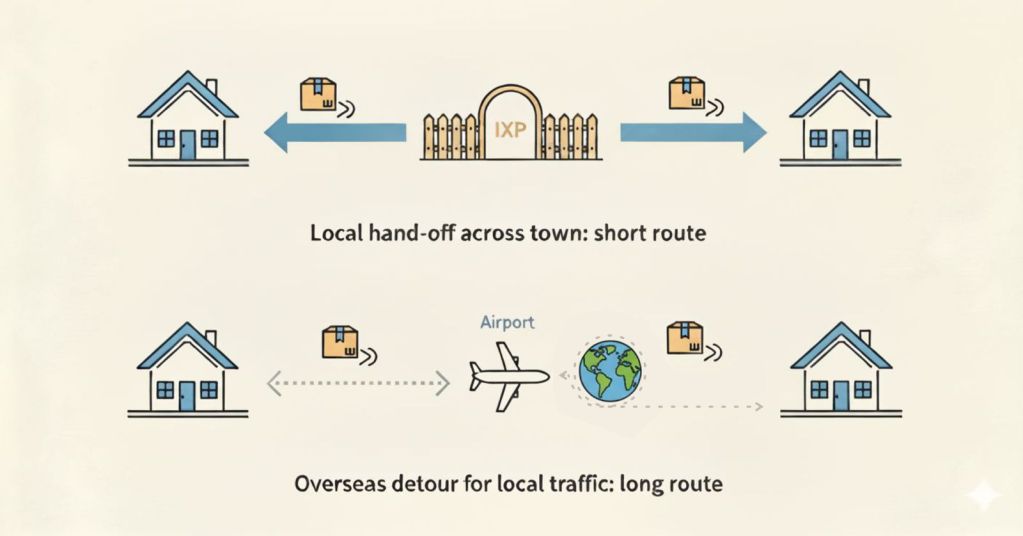
- Without peering: data between two users in Accra can travel out of Ghana and back again.
- With peering: the hand‑off happens in Accra, so the journey is short.
Two simple ways to peer
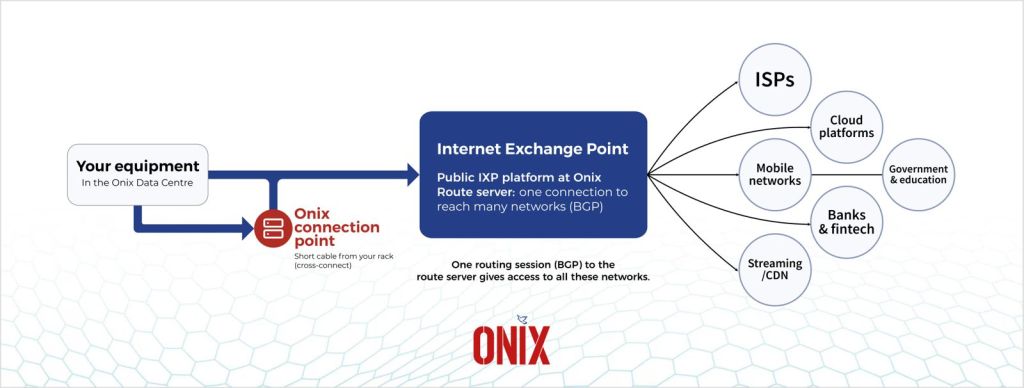
- Public peering: many networks use the same meet‑up and agree to exchange traffic. One connection gives access to lots of partners.
- Private peering: two networks run a short, dedicated cable inside the building (a cross‑connect) to swap high‑volume or critical traffic.
What you get
- Fewer stops on the journey, lower delay and fewer failures.
- Lower costs than sending everything over long, paid international routes.
- A local path that keeps Ghana‑to‑Ghana traffic in Ghana.
Why peering matters especially in Ghana and across Africa
- Performance. Fewer hops and shorter paths make pages snappier, streams smoother and calls clearer.
- Resilience. Local paths keep services available during issues on international links or congested upstreams.
- Cost. Exchanging local traffic at an IXP reduces spend on international transit and backhaul.
- Data locality. Ghana‑to‑Ghana traffic stays in country, supporting sovereignty and compliance goals.
- Ecosystem lift. When ISPs, CDNs and content networks peer locally, the whole market benefits.
Why multiple IXPs inside one carrier‑neutral site matter
Having more than one exchange in the same building is good for everyone.
- More networks to reach. Two exchanges mean more potential peers without building new long links.
- Built‑in backup. If one platform has an issue or planned work, the other keeps traffic flowing.
- Better performance. Pick the faster path for each service and move heavy traffic where it runs best.
- Simple operations. The same meet‑me rooms and cross‑connect process serve both exchanges.
- Easy growth. Start small, add capacity or a second port as traffic grows; use private links for busiest routes.
- More local traffic. With more peers in Accra, more Ghana and West Africa routes stay in country.
Who benefits and how
- Financial services and fintech. Faster authorisations and fewer timeouts at peak.
- Media, CDN and gaming. Less buffering and fairer, more stable ping.
- Cloud, SaaS and collaboration. Crisper meetings and quicker syncs for staff and customers.
- Public sector, health and education. More reliable portals, telemedicine and e‑learning.
- E‑commerce and logistics. Speedier checkouts and real‑time tracking.
What customers should ask their providers
- Are you peering at exchanges inside Onix, and do you keep Ghana‑to‑Ghana traffic local?
- Can you show evidence of peering (looking‑glass, portal or published policy)?
- Can you provide private peering or cross‑connects in Onix when needed?
- How do you secure routing (IRR/RPKI, max‑prefix), and do you have resilience across more than one exchange?
If a supplier cannot give clear answers, ask why. Many networks in Accra do peer — switching is often easier than expected.
How peering actually works at Onix
- Connect. Place your router or switch in Onix, or take a meet‑me room cross‑connect to the exchange fabric.
- Order a port. Choose a port speed that fits today, with a clear upgrade path.
- Set up BGP. Use route servers for quick reach; add key bi‑laterals where policy or scale needs it.
- Measure and scale. Prefer local paths for Ghana prefixes, monitor latency and loss, add private interconnects for heavy flows, and keep routing hygiene tight (IRR/RPKI).
Getting started at Onix
Whether you are an ISP, a content platform, a university, a bank or a cloud‑first enterprise, the route to peering is straightforward.
- Discuss your traffic map. Identify Ghana‑heavy flows that will benefit most from local exchange.
- Pick your first IXP port. Start where you gain the most reach, then consider a second port on the other fabric for resilience and additional peers.
- Measure and iterate. Track latency, jitter, packet loss and costs. Add bi‑lateral sessions or private interconnects for your biggest paths.
Onix can help with options inside the facility, from meet‑me room cross‑connects to space and power for your network kit. The IXPs operating in the building provide guidance on joining, configuration and ongoing best practice.
Common myths to retire
- “Peering only helps big content players.” Local SMEs and public bodies feel the gains through faster apps and fewer failures.
- “It is complicated.” Modern IXPs provide route servers, documentation and support. For most networks the initial set‑up is measured in days, not months.
- “Transit already solves this.” Transit is still important, but it is not optimised for local hand‑offs or for keeping domestic traffic in country.
Simple glossary
- IXP (Internet Exchange Point): a neutral platform where many networks interconnect and exchange traffic.
- Peering: voluntary exchange of traffic between networks.
- Transit: paid connectivity that carries your traffic to the wider Internet, often via international routes.
- Latency: the time a packet takes to travel to its destination and back.
- Cross‑connect: a dedicated cable that links two parties inside a facility for private traffic exchange.
- Route server: an IXP service that lets many networks exchange routes without separate sessions with every peer.
What is next for you?
If you operate a network, a content platform or any data‑heavy service, join the exchanges inside Onix and keep your local users close. If you are an enterprise buyer, make peering a procurement requirement and choose partners that prove they keep Ghana traffic in Ghana.
Next step: speak with your current providers about their peering posture in Accra. If you want an independent view, the Onix team can help you map routes, benchmark performance and plan the quickest path to better user experience.
Get started with LINX Accra at Onix: visit http://www.onixdatacentres.com/linx to learn more, check options and request a port.