
The year reliability stopped being an IT detail
In 2026, the biggest competitive advantage is not innovation. It is reliability.
For much of the last decade, digital strategy was defined by growth. More users, more data, more platforms, more speed. Infrastructure existed to keep up, quietly supporting ambition from the background.
As we enter 2026, that framing no longer holds.
Today’s digital economy assumes that systems simply work. Payments clear instantly. Applications respond in real time. Data is available when it is needed. When something fails, customers rarely ask why it happened. They remember only that it did.
That shift has fundamentally changed the role of infrastructure. Reliability is no longer an operational concern delegated to technical teams. It has become a strategic decision that shapes growth, trust, and reputation.
In 2026, reliability is strategy.
When reliability moved from IT to leadership
Several forces have pushed reliability out of the server room and into the boardroom.
First, digital dependency is now universal. Core business operations across finance, telecommunications, healthcare, logistics, and public services rely on continuous availability. Downtime is no longer inconvenient. It is disruptive.
Second, real-time expectations have hardened. Users do not experience systems as “best effort”. They experience them as promises. Maintenance windows, explanations, and apologies are largely invisible from the outside.
Third, risk exposure has widened. Cyber security, data protection, regulatory compliance, and reputational trust are now inseparable from infrastructure decisions. Where and how systems are hosted is no longer purely technical. It is a governance issue.
Finally, the cost of failure has become asymmetric. A single outage can undo years of credibility, while flawless operation attracts little attention. Reliability is most valuable precisely because it goes unnoticed.
Reliability is invisible until it isn’t.
Together, these forces mean that infrastructure choices increasingly determine competitive advantage.
The four decisions that define reliability
Every reliable digital platform makes the same four decisions, whether consciously or by accident. While the engineering behind them may be complex, the strategic questions leaders need to ask are not.
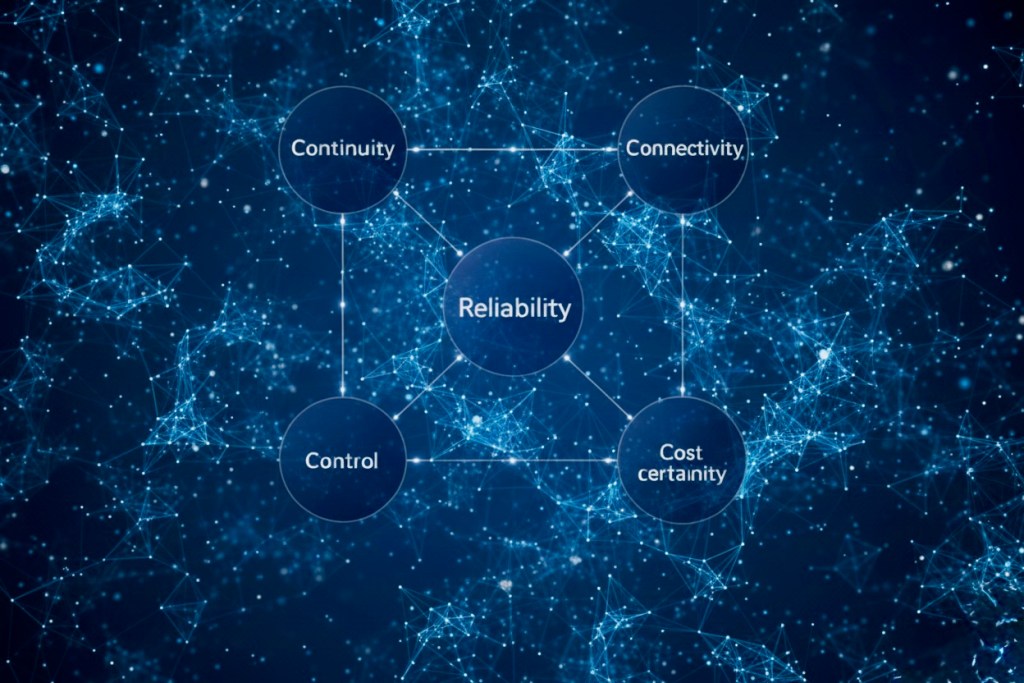
Continuity
Can operations continue through power events, equipment failures, and external disruption? True continuity is designed, tested, and operationalised long before it is needed. It is not an emergency response; it is a baseline.
Connectivity
Is there genuine choice and diversity in how systems connect to users, partners, and cloud platforms? Flexible, carrier-neutral connectivity improves performance, increases resilience, and reduces long-term lock-in.
Control
Are security, access, monitoring, and governance treated as disciplines rather than add-ons? Control underpins trust, compliance, and confidence in daily operations.
Cost certainty
Are operating costs predictable over time? Energy strategy, efficiency, and operational discipline matter as much as headline pricing. Uncertainty compounds quietly, and usually expensively.
When these four decisions are aligned, reliability becomes a platform for growth rather than a constraint on it.
Why this matters more in fast-growing markets
In rapidly expanding digital economies, the margin for error is smaller.
Across West Africa, digital services are scaling quickly. Financial platforms, connectivity providers, e-commerce, health systems, and government services are all becoming more data-driven and more interconnected. User expectations are shaped globally, but infrastructure realities remain local.
In this environment, instability is felt more acutely and forgiven less often. Infrastructure decisions have outsized consequences. Choices around location, power, redundancy, and connectivity can determine whether services scale smoothly or struggle under pressure.
Designing for reliability early removes fragility from growth. Deferring it simply shifts risk into the future.
What the quiet winners of 2026 are doing differently
The organisations best positioned for the coming years tend to share a set of understated behaviours.
- They design for failure rather than assuming perfection.
- They invest once in resilience instead of repeatedly paying the cost of outages.
- They treat user experience as an infrastructure outcome, not only a product feature.
- They prioritise connectivity choice and ecosystem access over short-term convenience.
- They view energy efficiency and sustainability as operational advantages, not public relations exercises.
- They build compliance readiness into their foundations rather than retrofitting it later.
- They plan migrations carefully, using experienced partners instead of relying on last-minute heroics.
None of these decisions are dramatic. All of them compound.
Reliability as a foundation, not a slogan
At Onix, we see this shift reflected in the questions organisations are now asking. Demand for reliable, high-availability digital infrastructure is increasing as businesses reassess what “good enough” really means.
Reliability is not something that can be added later. It is the result of deliberate choices across power, cooling, connectivity, security, and operational discipline, made with the long term in mind.
As the first working weeks of 2026 begin, the question for digital leaders is no longer whether reliability matters. It is whether their infrastructure treats it as a strategic priority.
Growth without reliability is not growth. It is risk.
Because in a world that assumes systems simply work, reliability is no longer just about staying online. It is about protecting growth, trust, and reputation.
And in 2026, that makes reliability strategy.
For organisations reassessing their infrastructure strategy in 2026, we welcome a conversation about resilience, connectivity, and long-term reliability. Contact us here.