
What really happens inside a Tier IV data centre when the power fails
It is 10:43 on a Tuesday morning.
A customer is completing an online payment. A doctor is retrieving a patient’s medical record. A logistics company is tracking a shipment across West Africa. Thousands of emails are being sent, cloud applications are running and video meetings are taking place.
Then, without warning, the power fails.
Across the city, office buildings fall silent. Lights go out, computer screens turn black and internet connections disappear. Employees stop what they are doing while businesses begin asking the same question: How long will this last?
Inside a Tier IV data centre, however, the experience is very different.
There is no rush to restart systems. No engineers sprinting to switch on generators. No interruption to the applications businesses depend on every day. In fact, when everything has been engineered correctly, the people using those applications should never even realise a power outage has occurred.
That is exactly what resilient infrastructure is designed to achieve.
Not Every Building Reacts the Same Way

Most organisations still operate critical systems from a server room somewhere inside an office building. While these rooms often contain capable hardware, they depend heavily on the building around them. When utility power fails, servers, networking equipment and cooling systems are suddenly placed at risk. Even a short interruption can lead to downtime, data corruption or lengthy recovery procedures.
A purpose-built Tier IV data centre is designed with an entirely different objective. Rather than simply housing servers, every aspect of the facility is engineered to remove single points of failure and maintain continuous operations, even when external infrastructure experiences problems.
The difference is not just better equipment. It is an entirely different philosophy. Instead of reacting to failure, the building has already been designed to expect it.
Power Never Stops. It Simply Changes Direction.
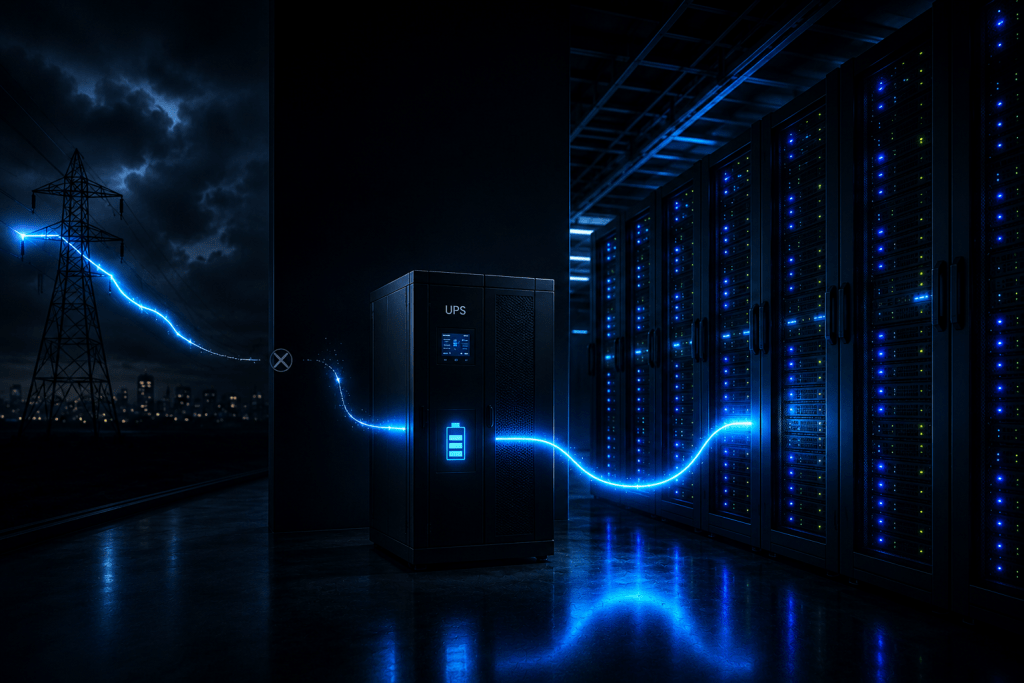
One of the biggest misconceptions about backup power is that generators immediately take over when electricity fails.
They do not.
The first line of defence is the Uninterruptible Power Supply, or UPS. The moment utility power disappears, the UPS responds in milliseconds, supplying stable electricity to the IT equipment without interruption. To the servers, storage systems and network switches, the transition is effectively invisible.
This is why resilient data centres are able to maintain continuous service. The flow of electricity never actually stops. It simply changes direction, moving from the national grid to stored electrical energy while the next stage of the power system prepares itself.
For customers accessing applications hosted inside the facility, there is no frozen screen or failed transaction. Their systems simply continue operating.
While the UPS Protects the Present, the Generators Secure the Future
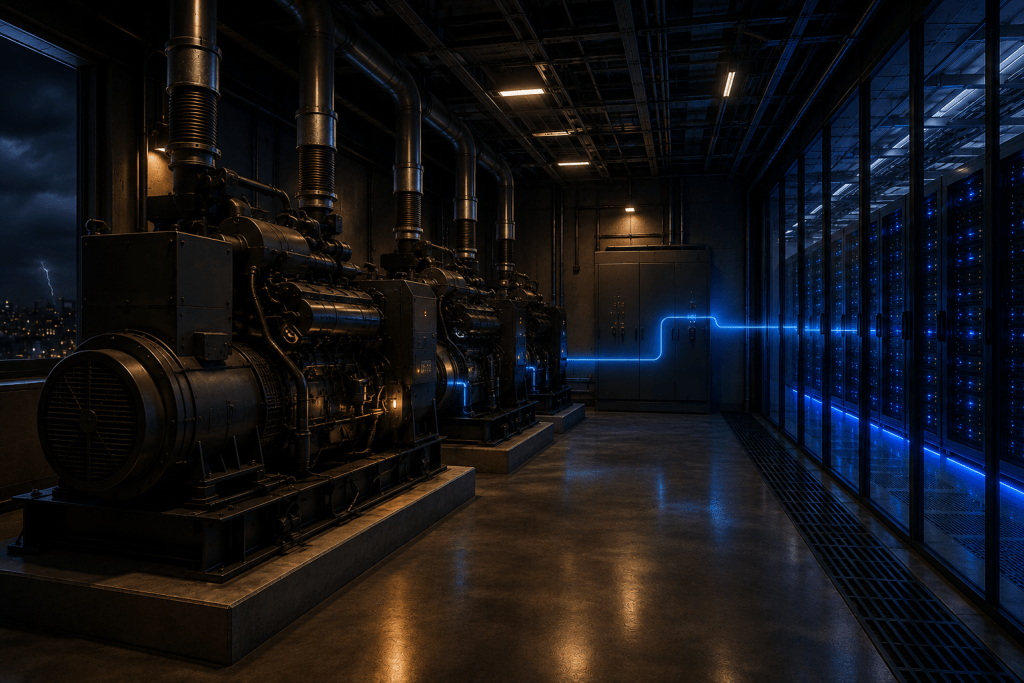
While the UPS quietly carries the electrical load, powerful backup generators automatically begin starting.
Within seconds they reach operating speed, synchronise with the facility’s electrical infrastructure and assume responsibility for powering the data centre. The transfer is carefully controlled to ensure there is no interruption to the critical systems already being supported by the UPS.
To someone standing inside the server hall, there is very little to see. Rows of servers continue processing information, cooling systems continue circulating conditioned air and network traffic continues flowing around the world.
The transition is almost uneventful—and that is precisely the point. In resilient infrastructure, success is measured by how little customers notice.
Keeping Servers Online Is Only Part of the Story
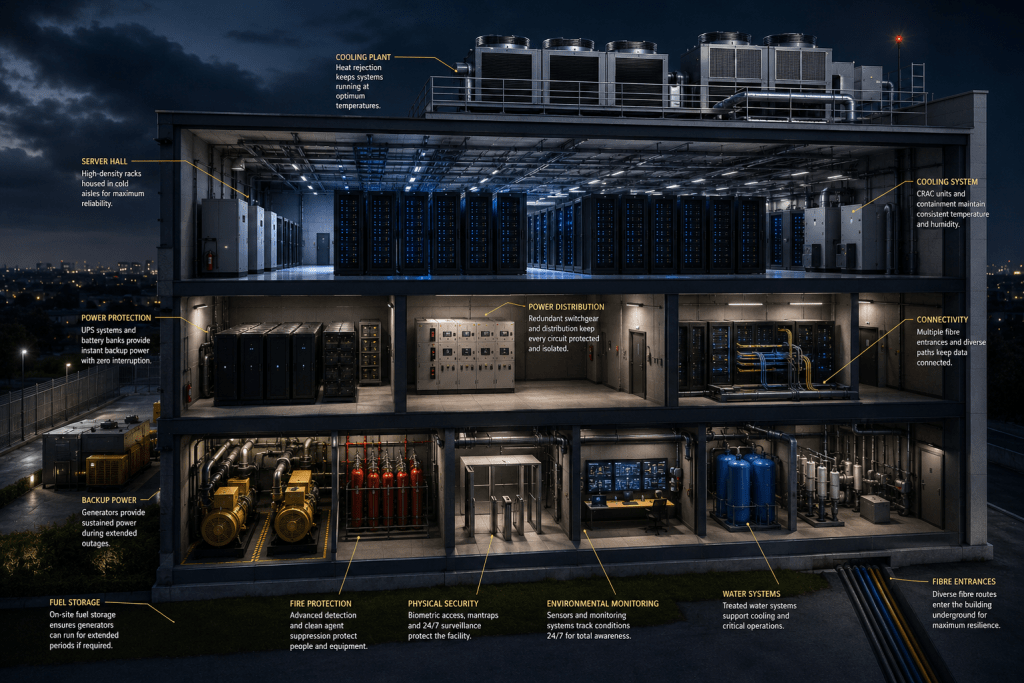
People often imagine a data centre as little more than rows of servers. In reality, those servers depend on an entire ecosystem working together.
Power systems, cooling infrastructure, fibre connectivity, fire protection, physical security and environmental monitoring all play an equally important role. If one element fails, the others are designed to continue operating without affecting the services running inside the facility.
This layered approach to resilience is what distinguishes enterprise-grade infrastructure from conventional server rooms. Every component has been designed to support the others, creating an environment where planned maintenance, equipment failures or external power disruptions can be managed without bringing customer services offline.
It is this combination of engineering, planning and operational discipline that allows businesses to place their critical systems in a data centre with confidence.
While the City Waits, Business Continues
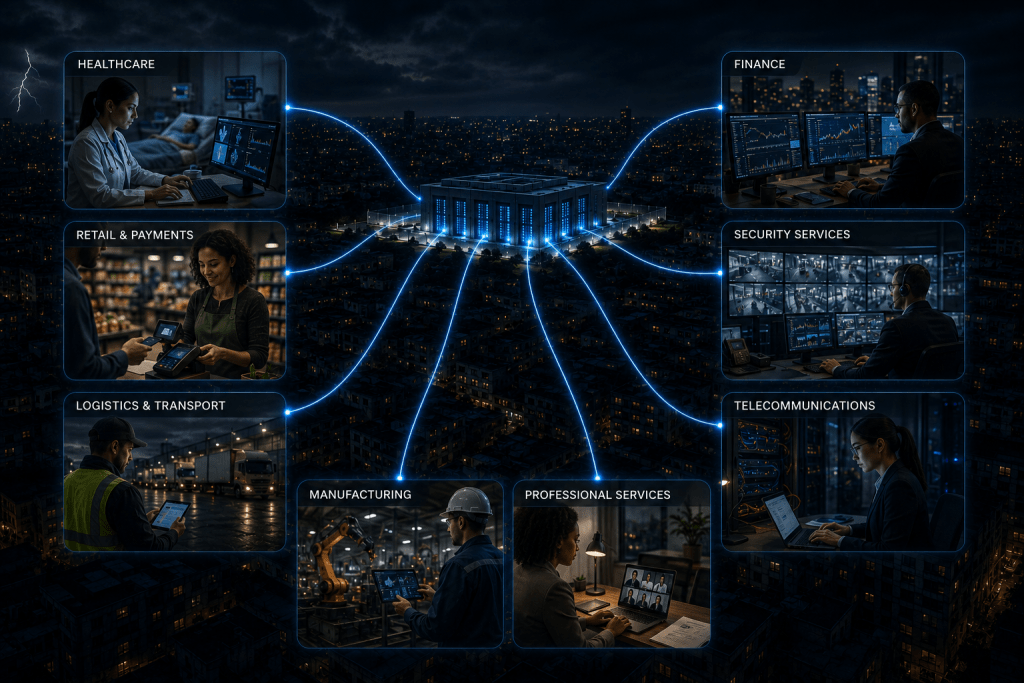
Outside, traffic lights may be out. Office buildings may still be waiting for electricity to return. Shops may have closed their doors until power is restored. Yet organisations hosting their critical infrastructure in a resilient Tier IV data centre continue serving customers as though nothing has happened.
Payments are processed. Healthcare systems remain accessible. Retail platforms continue accepting orders. Manufacturers maintain visibility across their supply chains. Financial institutions continue delivering digital services without interruption. For those organisations, the power outage becomes someone else’s problem.
That is ultimately the purpose of resilient infrastructure. It is not about keeping a building illuminated or demonstrating impressive engineering. It is about ensuring that businesses can continue operating, protecting revenue, customer confidence and organisational reputation when unexpected events occur.
Power failures are inevitable. Downtime should not be. When resilience has been designed into every layer of a facility, the best power outage is the one your customers never even realise happened.
About Onix Data Centres
At Onix Data Centres, resilience is engineered into every layer of our Tier IV infrastructure. From redundant power systems and resilient cooling to secure connectivity and 24/7 operational monitoring, every component is designed to help organisations maintain business continuity, even when the unexpected happens.
Whether you’re colocating critical infrastructure, supporting cloud platforms or delivering digital services across West Africa, Onix provides the resilient foundation your business depends on.
Discover how Onix can help keep your business online, whatever happens outside.