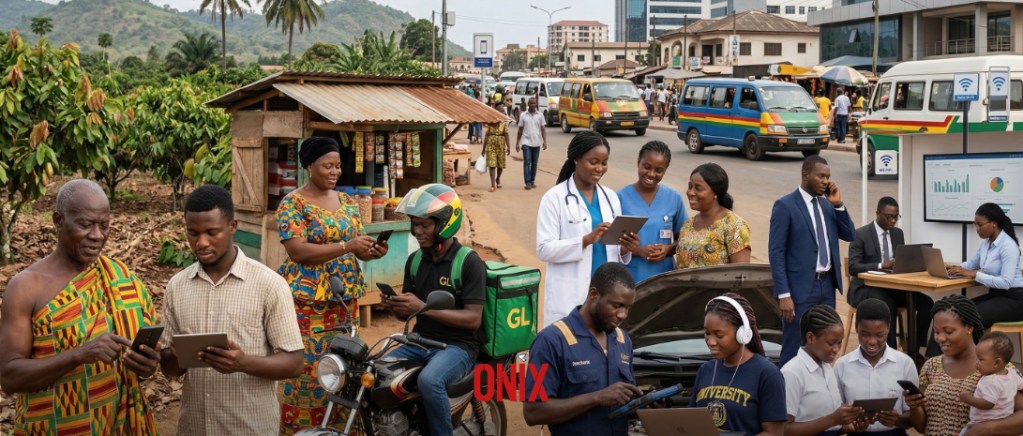
As Ghana celebrates 69 years of independence this March, there is also a bright digital story to share: more people are online, more payments are happening instantly, and more foundations are being built for the next wave of opportunity.
A new kind of independence story
In 2026, Independence Day on 6 March was observed nationwide as a statutory public holiday. Alongside parades, flags, and community pride, the day is also a quiet celebration of progress you can feel in everyday life: faster connections, easier trade, and more services within reach from a phone.
Connectivity in everyday life
Recent “state of digital” estimates indicate that by the end of 2025, Ghana had 26.3 million internet users, which is 74.6 percent of the population.
The same source reports 41.8 million cellular mobile connections, equivalent to 119 percent of the population, reflecting the very normal habit of using more than one SIM or device.
That shift matters because connectivity is not just social. It is access to learning, to customers, to markets, and to new ways of working, especially in mobile first communities.

Mobile money is now routine
One of the happiest signals of a digital nation is how ordinary digital payments have become. Data from the Bank of Ghana show that by December 2025, mobile money reached 80.5 million registered accounts and 26.7 million active accounts.
In that same month, mobile money recorded 982 million transactions worth GH¢518.4 billion.
This is not just growth. It is convenience and confidence showing up in daily routines, from paying suppliers to sending support to family.
Strong rules and sturdy foundations
Trust is built on clear rules. In a February 2026 press release, the Bank of Ghana reported that Ghana retained the top position globally in the GSMA Mobile Money Regulatory Index 2025, scoring 96.10 percent.
The same release notes that the index assesses regulatory effectiveness across 90 countries, which makes the ranking a strong signal of credibility for Ghana’s digital finance ecosystem.
Ideas also need infrastructure behind them. Ghana’s data centre market is growing, with Xalam Analytics estimating 6.5MW of live critical IT load in 2025, a further 5MW in construction, and a long-term pipeline of 10MW or more. That matters because digital progress depends on resilient infrastructure beneath the surface. At Onix, we see that as part of the bigger national picture: as more services, platforms and transactions move online, the need for secure, always-on, high-resilience infrastructure only grows. Our Tier IV facility in Accra is part of that foundation, helping support the reliability, performance and confidence a growing digital economy demands.
What comes next
There is still room to grow. Internet penetration figures imply that roughly a quarter of the population remains offline.
At the same time, national programmes are explicitly focused on widening broadband access, improving digital public services, and strengthening the digital innovation ecosystem, as documented by the World Bank for the Ghana Digital Acceleration Project.
So, at 69, Ghana can celebrate a digital economy that is becoming more practical, more trusted, and more ready to serve the next generation of builders.
Behind every connected service is infrastructure built for trust and continuity. See how Onix is helping support Ghana’s digital progress with resilient, Tier IV infrastructure in Accra. Contact us to learn more about our offerings.