A Ghanaian business can reach an awkward stage in its growth. The servers that once supported a relatively small operation now hold financial records, customer systems, internal applications or services used across several locations. They still belong to the business, and the IT team still wants control of them, but the ordinary office around them was never designed to become critical digital infrastructure.
That creates a reasonable question: if we still want to own and control our servers, why would we put them in somebody else’s building?
The answer is the idea behind colocation.
What is colocation?
Colocation is an arrangement in which an organisation places its own dedicated IT equipment in a professionally operated data centre. The customer generally retains control of its servers, applications and data, while the colocation provider supplies agreed facility services such as space, power, cooling, physical site controls and access to connectivity.
The precise boundary depends on the contract, which is important. Colocation does not mean handing the entire IT operation to somebody else.
Instead, it separates two jobs that are often bundled together inside an office: running the organisation’s technology and running the physical environment that keeps that technology operating.
What does the customer bring and control?
In a conventional colocation arrangement, the customer may own the physical servers, storage equipment, network devices and other hardware installed at the facility.
The customer would normally continue making many of the important technology decisions. These can include which applications run on the servers, how operating systems are configured, who has access to data, how software is licensed, how information is backed up and how systems recover following a failure.
Cybersecurity responsibilities also continue. Putting a server in a professionally operated data centre does not remove the need to patch software, protect user accounts, configure systems correctly, monitor applications or manage access to sensitive information.
Some of those responsibilities can be assigned to other suppliers under separate arrangements, but that should never be assumed simply because equipment is colocated.
What does the colocation provider supply?
The provider takes responsibility for the parts of the environment included in the colocation service agreement.
Typically, that means providing an agreed amount of physical space for equipment together with facility infrastructure such as electrical power and cooling. It can also include physical site controls, environmental monitoring and ways for customers to connect to telecommunications providers.
This is why describing colocation as simply “renting rack space” misses much of the point. The rack has little value on its own. What an organisation is buying is access to a specialist environment designed to support IT equipment without requiring that organisation to construct and operate the whole facility itself.
What colocation is not
Colocation is not the same as public cloud computing. With public cloud, organisations generally consume computing resources provided through a cloud platform rather than installing their own physical servers in a rack. Cloud resources can usually be provisioned and changed through software, and responsibility for the underlying physical infrastructure sits with the cloud provider.
Colocation is also not automatically managed hosting. A company can place its equipment in a data centre while continuing to administer that equipment itself or through its chosen IT provider.
Nor does moving into colocation make an organisation automatically secure or compliant. The facility can form part of a sound security, continuity or compliance architecture, but the customer still has responsibilities covering its own systems, people, data, processes and legal obligations.
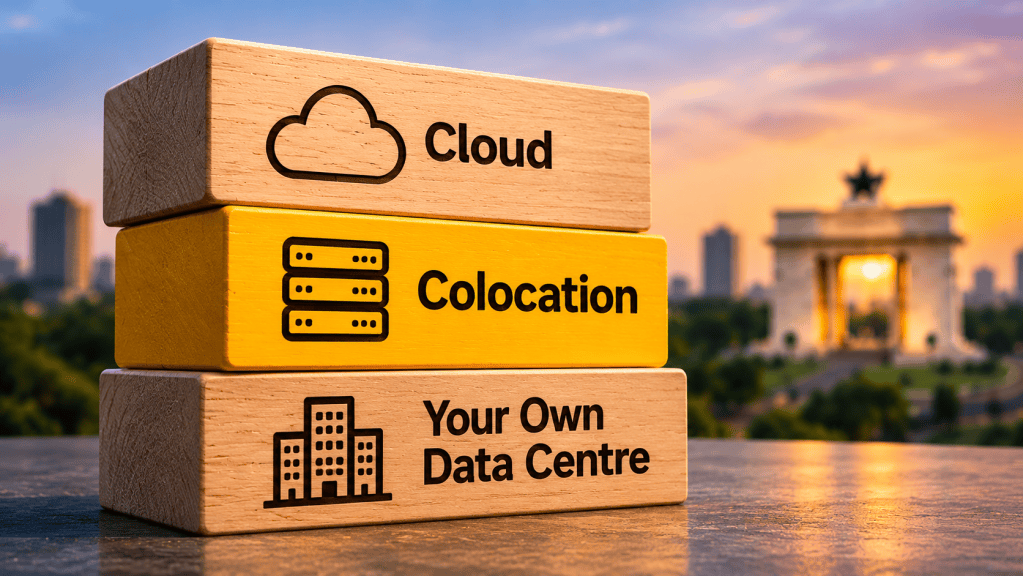
Office server room, colocation or public cloud?
There is no universally correct model. The useful question is which responsibilities an organisation wants to retain and which infrastructure it makes sense to operate itself.
| Office server room | Colocation | Public cloud | |
|---|---|---|---|
| Physical servers | Usually owned by the organisation | Usually owned or controlled by the customer | Underlying hardware normally belongs to the cloud provider |
| Physical environment | Organisation manages it | Colocation provider manages agreed facility infrastructure | Cloud provider manages it |
| Hardware control | High | High | Usually lower at physical-hardware level |
| Scaling | Requires buying and installing equipment and supporting infrastructure | Customer equipment can be added subject to facility/service availability | Resources can often be provisioned rapidly through the cloud platform |
| IT management | Customer responsibility | Customer responsibility unless separately contracted | Divided between provider and customer depending on the cloud service |
| Capital equipment | Customer may need facility and IT investment | Customer generally retains investment in its own IT hardware but uses a third-party facility | Typically consumption-based rather than purchasing the underlying cloud infrastructure |
| Best suited to | Situations where running infrastructure internally remains justified | Organisations wanting dedicated equipment without operating the complete physical environment themselves | Workloads suited to on-demand cloud services and the relevant service model |
| Main trade-off | Maximum direct control, but responsibility for the complete environment | Retains hardware control while introducing another provider and contractual boundary | Greater abstraction and flexibility, with different cost, control and dependency considerations |
The shared-responsibility boundary matters
The most important part of a colocation agreement may be the boundary between the provider’s responsibilities and the customer’s.
Suppose an application stops working. The cause could sit in the facility power supply, the customer’s server hardware, an operating-system configuration, a network service, an expired software licence or the application itself. Different organisations may be responsible for each layer.
Before signing a contract, a customer should therefore understand who monitors each part of the service, who is contacted when something fails, what support is included, who is permitted to touch the equipment and how incidents involving several suppliers are coordinated.
This is particularly important for security, backup and disaster recovery. Physical protection of a facility does not replace cybersecurity inside the customer’s systems, and resilient facility infrastructure does not by itself create a complete recovery strategy.

Why businesses sometimes use colocation and cloud together
Colocation and cloud are not necessarily competing choices. An organisation can use both.
For example, it might retain particular systems on dedicated equipment while using public cloud services for other applications, development environments or services that benefit from rapid scaling. Another organisation may keep existing hardware rather than replacing a working platform simply because it is adopting cloud elsewhere.
The appropriate mix depends on workload requirements, cost, skills, contractual commitments, data considerations, recovery plans and the level of control the organisation wants.
When might a Ghanaian organisation consider colocation?
Colocation may be worth investigating when important equipment has outgrown the environment in which it is operating, when an organisation wants to retain dedicated hardware without continuing to run the supporting facility itself, or when power, cooling, physical access and connectivity have become significant operational concerns.
It can also be relevant during an office move, hardware refresh, business-continuity review or expansion into new digital services.
That does not mean moving everything. A review may conclude that some systems should remain where they are, some should be colocated and others are better suited to cloud services.
What should you ask before choosing colocation?
Start with the service boundary rather than the sales brochure. Ask exactly what is included in the price, which equipment remains your responsibility, how power and connectivity are contracted, how authorised access works, what happens when your engineers need assistance and how incidents are escalated.
You should also understand the provider’s resilience evidence, certification scope, connectivity options, contractual service levels, maintenance arrangements, expansion process and exit terms. If the systems are subject to regulatory, contractual or customer requirements, your own risk, legal, security and compliance teams should determine what evidence they require.
A physical visit can be useful as part of that due diligence. Onix’s guide Beyond the Racks: Why a Data Centre Tour Matters explains what different business and technical teams can learn from seeing the environment themselves.
Where Onix fits
Onix operates a data-centre facility in Accra, Ghana. Onix is a carrier-neutral colocation provider, offers colocation and related infrastructure services, and provides access to multiple networks and internet exchanges.
For organisations examining facility resilience, Onix Accra holds Uptime Institute Tier IV Certification of Design Documents and Uptime Institute Tier IV Certification of Constructed Facility. Tier certification verifies the topology of the certified facility scope; it should not be interpreted as an automatic uptime percentage or as a guarantee covering a customer’s complete application environment.
If your organisation is deciding where and how to operate business-critical equipment, speak with Onix or arrange a visit to understand the colocation environment and the responsibilities involved. Colocation will not be the right answer for every workload, but a clear discussion of the options can help establish whether it deserves further investigation.
Key takeaways
- Colocation normally allows an organisation to keep control of its own dedicated IT equipment while using a specialist data-centre environment.
- The provider and customer remain responsible for different layers, and those boundaries should be explicit in the service agreement.
- Colocation is different from public cloud and does not automatically include managed IT, cybersecurity or compliance.
- Office infrastructure, colocation and cloud each involve different combinations of ownership, control, flexibility, cost and responsibility.
- Many organisations can use colocation and cloud together rather than treating them as mutually exclusive choices.
Frequently asked questions
What is colocation in simple terms?
Colocation means placing your organisation’s own IT equipment in a specialist data centre operated by another company. You continue to control the equipment and the systems running on it, while the provider supplies the agreed physical environment and facility services.
Does the customer still own the servers?
In a typical colocation arrangement, yes. The customer generally owns or controls the servers and other installed equipment. The exact commercial arrangement should always be confirmed in the contract.
Is colocation the same as cloud computing?
No. Colocation normally involves identifiable physical equipment dedicated to the customer. Public cloud involves consuming computing resources from infrastructure operated by a cloud provider, with responsibility divided according to the type of cloud service being used.
Who is responsible for cybersecurity in a colocation arrangement?
Responsibility is shared across different layers. The data-centre operator may be responsible for agreed physical and facility controls, while the customer normally remains responsible for areas including its applications, data, configurations, accounts and many cybersecurity decisions. Contracts should define the precise boundary.
When might a business consider colocation?
It may be worth investigating when business-critical equipment has outgrown an office environment, when an organisation wants to retain dedicated hardware without operating the whole facility supporting it, or when infrastructure requirements are changing because of growth, resilience, regulatory or business-continuity considerations.