Most of us rely on data centres many times a day without seeing one. A payment is approved. A business system retrieves a record. A message reaches a colleague. Behind these familiar actions sits physical infrastructure, operating in real buildings and supported by people whose work is usually out of public view.
A data centre tour gives that infrastructure a place, a scale and a human face. Visitors do not need to become data-centre engineers. The value lies in understanding what supports their digital services, seeing how the different parts fit together and meeting some of the people they may depend on when important work is under way.
Digital infrastructure is usually invisible
Data centres are controlled environments by design. Access is restricted, operational information is protected and much of the work happens quietly behind secure boundaries.
That necessary distance can make infrastructure feel abstract. Power, cooling, connectivity and monitoring may appear as separate lines in a proposal rather than interconnected systems. Operational support can sound like a service category rather than work performed by real people following procedures, making judgements and communicating across teams.
A visit closes some of that distance without compromising the controls that keep the environment secure.
Seeing the systems changes understanding
A well-guided tour helps visitors form a mental picture of the whole environment.
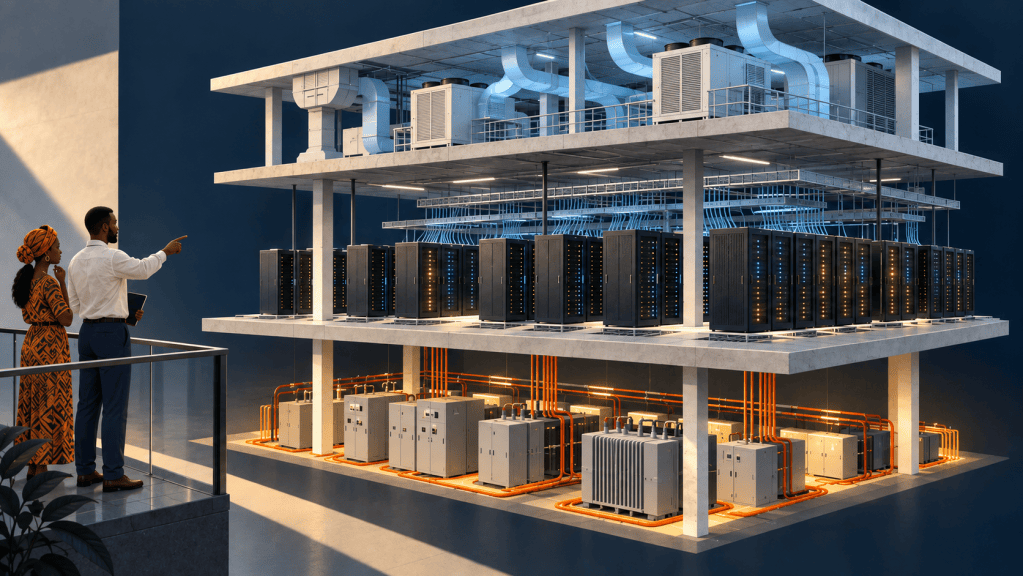
They can see that servers do not operate independently. They rely on electrical infrastructure, cooling, network connectivity, environmental monitoring, physical security and established operating processes. Each has a different purpose, but their value comes from how they work together.
This does not mean every room, system or procedure should be exposed. A responsible tour follows an approved route and keeps sensitive details out of view. The objective is not unrestricted access. It is a clear, proportionate explanation of the environment and the responsibilities involved in operating it.
That context is useful across different roles. Infrastructure teams may concentrate on technical dependencies. Risk and audit professionals may consider evidence and control ownership. Procurement teams may listen for the boundary between included services and customer responsibilities. Senior leaders may gain a clearer view of what an infrastructure decision involves beyond price and space.
How a data centre tour helps people ask better questions
Specifications are important, but it is easier to question them when you can place them in context.
A visit can move a conversation from “Is maintenance covered?” to “How are planned activities communicated, approved and coordinated?” Instead of asking only whether access is secure, a visitor can ask how authorised access would work when engineers need to perform urgent work. A broad question about support can become a practical discussion about responsibilities, escalation contacts and the information each party needs during an incident.
For teams preparing a move, these observations can add useful context to a data centre migration plan. For risk, audit and procurement teams, the visit may help identify evidence that should still be requested, including maintenance records, test results, current certification details, contractual commitments and responsibility matrices. Onix’s CISD 2026 infrastructure article explores that evidence-based approach for Ghana’s regulated financial institutions.
The goal is not to leave with every answer. It is to leave with better questions.
The people are part of the infrastructure
Dependable data centre operations involve equipment, engineering and automation. They also involve trained people, documented procedures, maintenance, communication and teamwork. Uptime Institute’s management and operations criteria similarly treat staffing, maintenance, training and planning as essential operational disciplines.
Meeting members of a data-centre team can therefore be as valuable as seeing the physical environment. Visitors can learn who coordinates planned work, who communicates when conditions change and how facility and customer teams would work together.
Human capability does not replace sound engineering or appropriate independent certification. It is what enables systems and processes to be operated with care.
The human connection works both ways
Much of a data-centre employee’s work may arrive as an alert, support request, maintenance task or change record. The organisation behind the equipment can remain almost as invisible to the operator as the data centre is to the organisation.
Meeting visitors can change that perspective. It can connect a technical responsibility with the people and services that depend on it. An operations professional may gain a better understanding of why a maintenance window matters to a particular organisation. A visitor may gain a clearer appreciation of the discipline behind what otherwise appears to be a simple support response.
This should not be presented as a measured outcome of every tour. It is a useful human possibility: people tend to work together more effectively when they understand one another’s context.

What visitors should leave with
A useful data centre visit should leave people with:
- a clearer understanding of the facility’s role;
- a better sense of who is responsible for what;
- more informed questions;
- an understanding of the people they may work with; and
- a list of evidence or follow-up information still required.
Different visitors will take away different things. A network engineer may notice operational dependencies. A procurement professional may identify an ambiguity in scope. A business-continuity leader may want to examine escalation and recovery arrangements. A student or early-career professional may discover an industry that had previously been hidden behind apps and screens.
A tour supports due diligence, but it does not complete it. Visual impressions and helpful conversations cannot replace documentary evidence, testing, contracts, professional advice or an organisation’s own risk assessment.
Bringing infrastructure and people into view
Onix operates a data-centre facility in Accra, Ghana. A guided visit offers an opportunity to see digital infrastructure as a physical and human working environment, while asking questions relevant to your organisation’s responsibilities and requirements.
See the infrastructure. Meet the people behind it. Book a guided tour of Onix.