
Africa’s digital infrastructure is undergoing rapid transformation. While South Africa, Nigeria, Egypt, Morocco and Kenya have traditionally dominated the data centre conversation, a new group of countries is stepping into the spotlight. Ghana is chief among them.
According to new insights from DC Byte, Ghana is now West Africa’s largest retail colocation hub by total IT capacity. Though live capacity remains modest today, the market is expected to grow tenfold in the coming years. Analysts already consider it a strong candidate for Africa’s next major hyperscale destination.
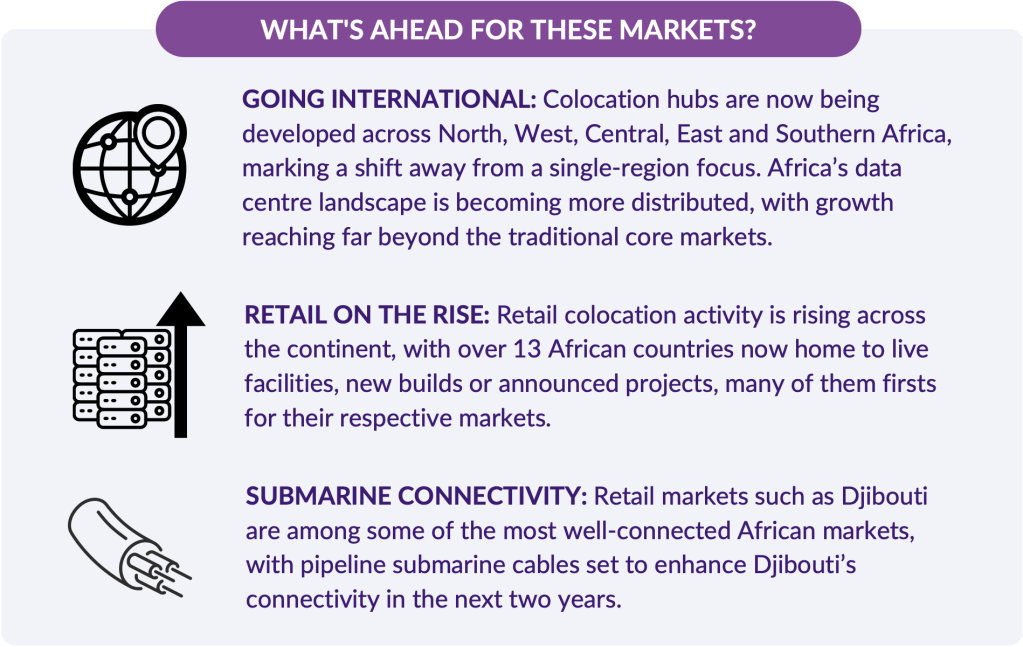
This growth is not an isolated development. It reflects a broader shift in the African data centre map. Capacity is no longer concentrated in a few core hubs. As DC Byte notes, North and West Africa now account for the second and third largest shares of tracked capacity across the continent. Ghana’s emergence marks a decentralisation of Africa’s digital backbone and a strategic pivot toward distributed infrastructure.
Ghana’s rise is being driven by three key factors:
- Connectivity and Strategic Positioning: The country is already served by multiple international submarine cables—including ACE, MainOne, GLO-1, WACS and SAT-3—which position it as one of the best-connected nations in West Africa. Its substantial and ever expanding carrier presence, along with improving interconnection options, is transforming Ghana into a connectivity gateway for cloud and content providers seeking low-latency infrastructure close to end users.
- Scalable, Sustainable Infrastructure: West Africa has over 440 MW of data centre capacity in the pipeline, and Ghana is set to take a significant share. Local operators are building at scale, combining technical resilience with green innovation. Facilities like Onix run entirely on solar power during the day, with battery systems planned to enable around-the-clock renewable operations. Smart water use, advanced cooling systems and waste recycling are helping to define new standards for environmentally responsible infrastructure on the continent.
- Market Readiness and Real Demand: This growth is not speculative—it is already underway. Colocation racks are filling fast. Demand is coming from banks, fintechs, ISPs, public agencies and international firms seeking local presence in West Africa. The ecosystem is shifting from early-stage development to an active, maturing marketplace. Ghana is no longer preparing for the digital future—it is living it.
Africa’s Evolving Data Centre Landscape: Key Trends
What This Means for the Industry
The momentum behind Ghana’s data centre sector sends a clear message to investors, hyperscale cloud players and regional enterprises alike: the infrastructure gap is closing, and first-movers are already reaping the benefits. For hyperscalers, this is a window to establish early dominance in a location with both local demand and strong onward connectivity. For African enterprises, it offers the chance to host data locally with higher resilience, lower latency and improved compliance.
For regulators and policymakers, Ghana’s emergence is a case study in the value of supporting open, carrier-neutral infrastructure and renewable energy adoption. It also reinforces the importance of aligning local regulation with the needs of an increasingly globalised digital economy.
Africa’s data centre map is changing. Ghana is not only part of that change. It is helping lead it.
To explore how your organisation can grow with Ghana’s digital infrastructure, get in touch with Onix