
Composable and Dynamic Infrastructure: A Simple Guide for Modern Digital Systems
For a long time, infrastructure has been built like a fixed layout. You decide what you need, you install it, you assign it, and then you try to keep everything stable for as long as possible. That approach made sense when change was slow and most systems did one job for years.
But modern digital work does not behave that way. Demand shifts quickly. Data grows in unpredictable bursts. Teams need environments at short notice. New products go live faster than ever, and customers expect services to stay reliable even when usage doubles overnight.
Picture this.
You launch a campaign and it actually works. Traffic spikes, but checkout slows: baskets lag, payments time out, and people leave. You feel it immediately. Sales drop right when demand is highest, your ad spend is wasted because you cannot convert, and support starts lighting up with complaints. Nothing is “broken”, your infrastructure just cannot shift capacity fast enough in the moment.
That is the problem composable and dynamic infrastructure is designed to solve. It is not about the physical side of a data centre. It is about designing compute, storage, and networking so they can be assembled and adjusted through software, quickly and repeatedly, without turning every change into a risky manual project.

What is composable infrastructure?
A simple way to understand composable infrastructure is to imagine your infrastructure as Lego blocks rather than fixed bricks.
With fixed bricks, you can build something solid, but it is hard to reshape without breaking the structure. With Lego blocks, you can keep the pieces, rearrange them, and build something new when your needs change.
Composable infrastructure applies that logic to three core resources:
- The processing power that runs applications
- Where data lives and grows
- How systems connect to each other and to users
Instead of treating those as tightly bound to specific machines and static configurations, composable infrastructure treats them as a flexible pool of resources. Software then “composes” the right mix for the workload you need to run.
The shift is not really about having more technology. The shift is about control. Instead of control being manual and slow, it becomes software-driven and repeatable.
What makes it different from traditional infrastructure?
Traditional infrastructure is usually built around fixed allocations. You choose a server for a workload, connect storage, configure the network, and keep it that way. If requirements change, you often have to make changes carefully, with tickets, change windows, and plenty of caution because one alteration can knock something else out.
Composable infrastructure is built for change from the beginning. You are not building one fixed “best guess”. You are building a system that can be adjusted without starting over.
In practical terms:
- Fixed allocations become on-demand assembly
- Manual provisioning becomes automated provisioning
- One-off configurations become repeatable templates

What does “dynamic” mean in plain English?
Composable is about being able to assemble resources flexibly.
Dynamic is about being able to adjust those resources as needs change, without drama.
In day-to-day terms, “dynamic” means the infrastructure can respond when:
- demand rises or falls
- a workload needs more storage temporarily
- a new service needs an environment quickly
- a system fails and must be recovered or rerouted
The goal is not constant motion for its own sake. The goal is that changes become normal, controlled, and predictable rather than rare, stressful, and disruptive.
Why does dynamic infrastructure matter right now?
Because modern workloads are unpredictable, even in organisations with good planning.
A few very normal examples:
- A campaign performs better than expected and traffic surges.
- A team needs a test environment immediately to fix a production issue.
- A data project grows quickly and suddenly needs more compute and storage.
- A platform launch creates peak demand for a week, then drops back down.
In older models, dealing with these events often means overbuilding “just in case”, or accepting delays because provisioning takes time. Composable and dynamic infrastructure aims for a better middle ground: use capacity more efficiently, and adjust when required.
This connects closely to how many organisations operate now:
- Hybrid approaches (mixing private systems with cloud services)
- Rapid dev and release cycles
- Large data workloads and analytics
- Always-on digital services that cannot afford downtime
How it works in practice
Imagine your organisation suddenly needs more compute and storage for analytics.
In a traditional environment, that might mean chasing approvals, waiting for change windows, and manually configuring new resources. The process can work, but it tends to be slow and risky, particularly when many systems share the same environment.
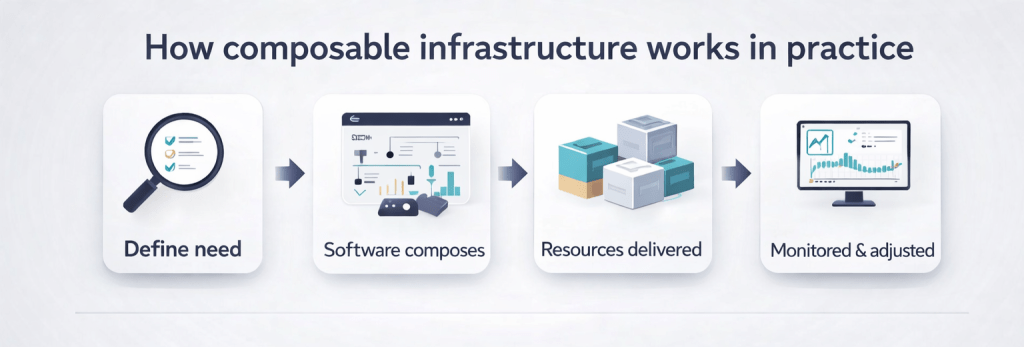
In a composable approach, it looks more like this:
- The requirement is defined (often as a template or policy).
- Software selects the right resources from what is available.
- The workload receives the resources and runs.
- Monitoring and policy keep things balanced over time.
The important point is that the adjustment is not dependent on rewiring or redesigning. It is driven by software logic and repeatable patterns.
Key benefits
Composable and dynamic infrastructure is valuable because it changes the effort required to deliver and adjust systems. It reduces the “friction” between what teams need and what IT can provide.
The benefits most organisations notice are:
- Provisioning and changes happen faster because processes are automated and repeatable.
- You reduce wasted capacity by allocating resources more precisely.
- Systems can grow or shrink without redesigning everything each time.
- Recovery and rerouting can be faster because reconfiguration is built into the approach.
- Templates and policies reduce one-off, fragile setups.
The hidden win is often the biggest one: fewer “special cases” and fewer manual fixes, which makes operations calmer and more dependable.
Where it is most useful today
Composable and dynamic infrastructure is most useful anywhere you have changing demand, multiple teams, or a mix of workloads that compete for resources.
Common use cases include:
- Hybrid environments that combine private systems and public cloud services
- Dev and test workflows that must spin up and down quickly
- Analytics, AI, and machine learning platforms with changing requirements
- SaaS platforms where usage rises and falls
- Enterprises modernising legacy systems while keeping core services running
Common concerns and misconceptions
It is worth addressing a few myths, because they often stop people from even exploring the idea.
- The principles apply at many scales. What changes is how much you implement at once.
- It can be complex if approached as a shiny upgrade. Done well, it reduces long-term complexity by replacing manual work with repeatable patterns.
- Lock-in is always something to watch in technology decisions, but composability is mainly an architectural approach. You can pursue the principles while still designing for long-term choice.
Infrastructure that bends to the business
Composable and dynamic infrastructure is not a trend for trend’s sake. It is the natural response to a world where demand changes quickly, digital services must stay reliable, and teams cannot afford long delays for basic infrastructure needs.
The core idea is simple:
Infrastructure should bend to business needs, not the other way around.
If you are building systems that need flexibility without constant rebuilds, composable and dynamic infrastructure should be part of your roadmap.
Building for flexibility starts with the right foundation. Speak to Onix Data Centres about hosting and connectivity that helps your digital systems scale reliably when demand changes.