
As demand for cloud, AI, fintech, digital services and localised infrastructure grows across Africa, businesses need to think earlier about where their critical systems will live. High-quality data centre capacity cannot be created overnight. The organisations that wait too long may still find a solution, but not always the best one.
For many businesses, digital infrastructure has traditionally been treated as a technical matter. Servers, networks, backup systems, cloud access and disaster recovery were often discussed after the commercial strategy had already been set.
That approach is becoming harder to sustain.Across African markets, digital demand is rising. Cloud adoption, fintech growth, AI experimentation, e-commerce, enterprise digitisation, public-sector platforms and data localisation requirements are all placing greater pressure on the infrastructure beneath the digital economy.
For CIOs, CTOs, CFOs, founders and boards, the question is no longer simply: Where should we host our systems? Increasingly, the question is: When do we need to secure the right infrastructure before our options narrow?
High-quality data centre capacity in Africa is becoming a timing issue because resilient, well-connected infrastructure requires long-term planning, available power, connectivity, operational maturity and room to scale. Businesses that wait until demand becomes urgent may find that the best-fit options are no longer as flexible, available or commercially attractive as they expected.
Digital growth is changing the infrastructure conversation
Africa’s digital economy is no longer a future concept. It is already visible in the daily operations of banks, fintechs, telecommunications providers, public agencies, healthcare platforms, logistics businesses, media companies and cloud-enabled enterprises.
The more digital a business becomes, the more exposed it is to infrastructure weakness.
A short outage may once have affected internal productivity. Today, the same disruption can affect customer trust, transaction flows, regulatory confidence, revenue collection, supply chains and public reputation.
For a fintech, it may mean interrupted payments. For a healthcare platform, it may mean reduced access to patient systems. For an enterprise, it may mean stalled operations across multiple locations. For a cloud-enabled business, it may mean degraded service at exactly the moment customers expect speed, reliability and availability.
This is why infrastructure decisions are moving closer to the boardroom. They are no longer only about IT efficiency. They are about business continuity, growth capacity, risk management and competitiveness.
Capacity is not only about space
When businesses think about data centre capacity, they often think first about physical space: racks, cages, private areas or larger dedicated environments. That is only one part of the picture.
The most valuable capacity is the capacity that comes with the right supporting conditions: resilient power, efficient cooling, multiple connectivity options, physical security, operational discipline, compliance readiness and room to scale. A rack in the wrong environment is not the same as a rack in a resilient, carrier-neutral, well-managed facility.
For serious organisations, the issue is not simply whether space exists somewhere in the market. The issue is whether the right kind of space exists, in the right location, with the right connectivity, resilience and support model. This distinction matters.
A business can often find a short-term technical workaround. It can extend an on-premises server room, negotiate more cloud capacity, move workloads temporarily, or delay a planned migration. But these decisions can create hidden costs: technical complexity, operational risk, poor latency, weaker disaster recovery and less flexibility when the business needs to grow.

Waiting can reduce strategic choice
Delaying a data centre decision rarely feels costly at first. Existing systems continue to run. Teams adapt. Internal server rooms are patched and extended. Cloud costs are accepted as part of doing business. Infrastructure planning is moved to the next quarter. The cost often appears later.
By the time a business is ready to move, its requirements may be more complex. It may need more power, better connectivity, a clearer compliance path, a stronger disaster recovery setup or a migration window that cannot interrupt live operations. At that point, the organisation is no longer making a calm strategic choice. It is trying to solve an urgent infrastructure constraint. That changes the balance of power.
Early planning gives a business room to compare options, design properly, negotiate sensibly, test migration plans and align infrastructure with growth. Late planning narrows the field. It can force compromises on layout, timing, network design, commercial terms or operational readiness. This is the quiet risk of waiting too long. The issue is not always that capacity disappears completely. It is that the best-fit capacity may no longer be available in the form, timeframe or configuration the business needs.
Resilience cannot be assembled at the last minute
There is a reason serious data centre infrastructure takes time. True resilience is not one feature. It is a system. It depends on how power is delivered and backed up, how cooling is designed, how connectivity enters the facility, how access is controlled, how incidents are monitored, how maintenance is managed and how operational procedures are followed every day.
For African businesses, this is particularly important. The operating environment can include grid instability, heat, connectivity variation, fuel logistics, regulatory pressure and rising customer expectations. Infrastructure must therefore be designed not only for ideal conditions, but for real-world continuity. A resilient facility is not simply a building with equipment inside it. It is an operating environment built around redundancy, discipline and control. That takes planning. It also takes experienced teams, tested processes and long-term investment. Businesses that treat resilience as something to arrange only when a problem appears are often already late.
Connectivity is becoming a competitive advantage
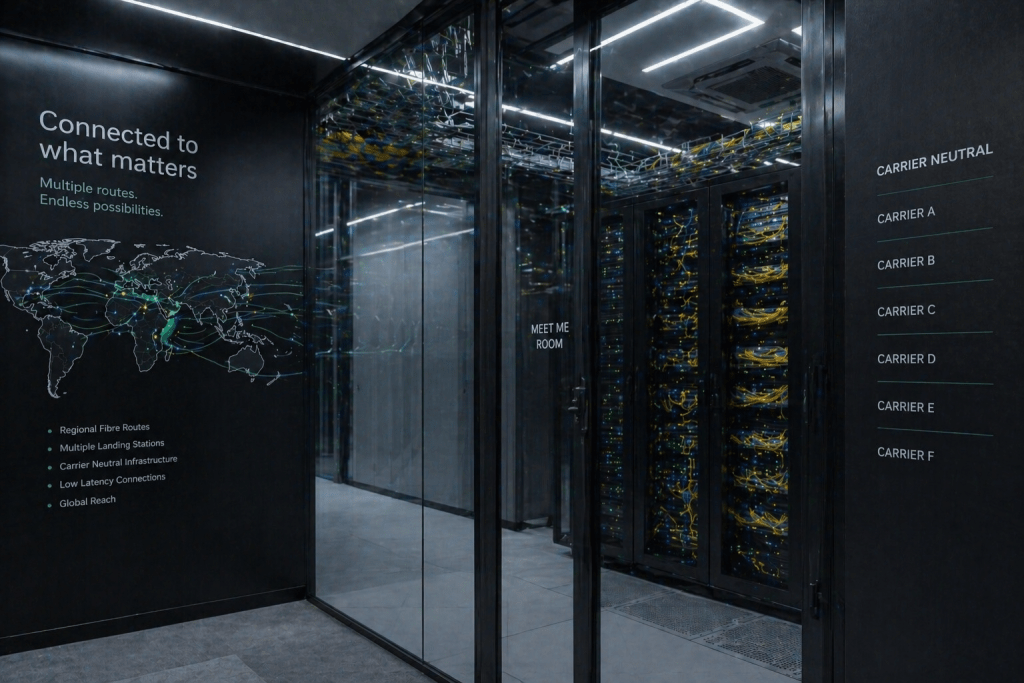
As more African businesses serve customers across regions, connectivity is becoming as important as compute. A well-connected, carrier-neutral data centre gives organisations more choice. It allows them to work with multiple network providers, connect to cloud ecosystems, improve redundancy and design better routes for traffic.
This matters for enterprises with regional branches, fintechs processing transactions, cloud platforms serving local users, content providers, ISPs and public-sector digital services. Carrier neutrality is particularly important because it avoids locking customers into a single network dependency. It allows infrastructure decisions to remain flexible as business needs change.
For growing organisations, that flexibility can become a competitive advantage. It can support better performance, lower latency, more resilient operations and stronger negotiating power over time. This is especially relevant in Ghana and West Africa, where the next phase of digital growth will depend not only on applications and platforms, but on the strength of the infrastructure underneath them.
The CFO case for early infrastructure planning
Data centre decisions are often led by technical teams, but the financial logic is equally important. On-premises infrastructure can appear cost-effective because much of the cost is already embedded in the business: space, power, cooling, security, staff time, maintenance contracts and periodic equipment replacement.
But when these costs are examined properly, the picture often changes. A professionally managed colocation environment can reduce the burden of owning and maintaining critical infrastructure directly. It can also help businesses move from large, unpredictable capital expenditure towards a more structured operating model.
The timing point matters here too. A company that plans early can phase migration, manage budgets, model growth and align infrastructure decisions with procurement cycles. A company that waits until systems are under pressure may have to move faster, spend less efficiently or accept short-term fixes that become expensive over time.
For CFOs, early infrastructure planning is not only about cost reduction. It is about financial control, risk reduction and preserving optionality.
AI, cloud and localisation will increase pressure
The next phase of demand will not come from one source. AI and analytics will require greater power density, stronger cooling and more reliable connectivity. Cloud adoption will continue to drive hybrid architectures, where some workloads sit in public cloud while others remain in controlled local environments.
Data localisation, compliance expectations and customer experience requirements will also encourage more organisations to bring critical workloads closer to African users.
This does not mean every business needs the same infrastructure strategy. Some will need full colocation environments. Others will need private cages, individual racks, disaster recovery capacity, cloud connectivity or a phased migration path. Some will need support from systems integrators. Others will need a facility that can support hybrid infrastructure, multiple carriers and future expansion.
But most will need to make decisions earlier than they have in the past. As demand grows, the best infrastructure decisions will be made before pressure becomes visible. Once growth arrives, infrastructure becomes harder to redesign without disruption.
What businesses should be asking now
The most useful infrastructure conversations start before there is an emergency.
Business leaders should be asking practical questions:
- Where will our critical systems need to sit over the next three to five years?
- How much power, cooling and rack capacity will we need if our growth plans succeed?
- Do we have enough connectivity choice, or are we dependent on too few providers?
- Can our current infrastructure support business continuity, compliance and customer expectations?
- If we had to migrate or scale quickly, would we have enough room to move?
These are not only technical questions. They are strategic planning questions.
For a CIO or CTO, they shape architecture and operational resilience. For a CFO, they affect cost control and capital planning. For a founder, they influence scalability and investor confidence. For a board, they touch risk, reputation and continuity.

Onix’s role in the market
Onix Data Centres is built around the principle that African businesses need infrastructure they can trust, scale and connect through.
Our Accra facility is carrier-neutral and designed for organisations that need resilient, secure and well-connected colocation capacity. Onix’s infrastructure includes access to multiple networks, dedicated Meet Me Rooms, robust security, advanced cooling, backup power systems and a strategic location outside the high-congestion centre of Accra.
The facility is positioned to support enterprises, financial institutions, connectivity providers, fintechs, public-sector platforms and other organisations building serious digital operations. The value of this type of infrastructure is not only in what it provides today. It is in what it allows customers to plan for tomorrow: growth, migration, regional expansion, cloud connectivity, disaster recovery and operational continuity.
The businesses that plan early will have more room to move
The infrastructure market rewards foresight. Businesses that begin early can ask better questions. They can test assumptions, evaluate providers, understand migration requirements, secure suitable capacity and build infrastructure around their growth strategy rather than around an emergency.
Those that wait may still find a solution. But it may not be the solution they would have chosen if they had started sooner. This is the shift now facing many African businesses. Infrastructure is no longer a back-office decision to be postponed until systems are under strain. It is a strategic timing decision that affects resilience, cost, performance and future growth. The companies that understand this early will be better positioned to scale with confidence.
At Onix Data Centres, we work with organisations that are planning not only for today’s requirements, but for the next stage of their digital growth. For businesses reviewing their infrastructure, resilience or colocation strategy, the right time to begin the conversation is before capacity becomes a constraint.
Frequently Asked Questions
Why should businesses plan data centre capacity early?
Businesses should plan data centre capacity early because resilient, well-connected infrastructure takes time to evaluate, secure, configure and migrate into. Waiting too long can reduce flexibility, limit suitable options and increase operational risk.
What makes high-quality data centre capacity different?
High-quality data centre capacity combines resilient power, efficient cooling, carrier-neutral connectivity, physical security, compliance readiness, operational discipline and room to scale. It is not only about rack space, but about the complete environment supporting critical systems.
Why does carrier-neutral infrastructure matter?
Carrier-neutral infrastructure gives businesses access to multiple network providers. This supports flexibility, redundancy, improved routing, better commercial choice and stronger long-term connectivity options.
Why is infrastructure timing becoming more important in Africa?
Infrastructure timing is becoming more important because demand for cloud, AI, fintech, digital services and localised data infrastructure is rising across African markets. As demand increases, businesses that delay planning may find fewer best-fit options available when they need to scale.
Why is Ghana important for digital infrastructure?
Ghana is increasingly relevant as a West African digital infrastructure hub because of its growing digital economy, connectivity position, financial services sector, public-sector digitisation and role as a regional business gateway.
Plan before capacity becomes a constraint
Digital infrastructure decisions are becoming timing decisions. Onix Data Centres supports organisations planning for resilient, carrier-neutral colocation, connectivity and business continuity across African markets.