
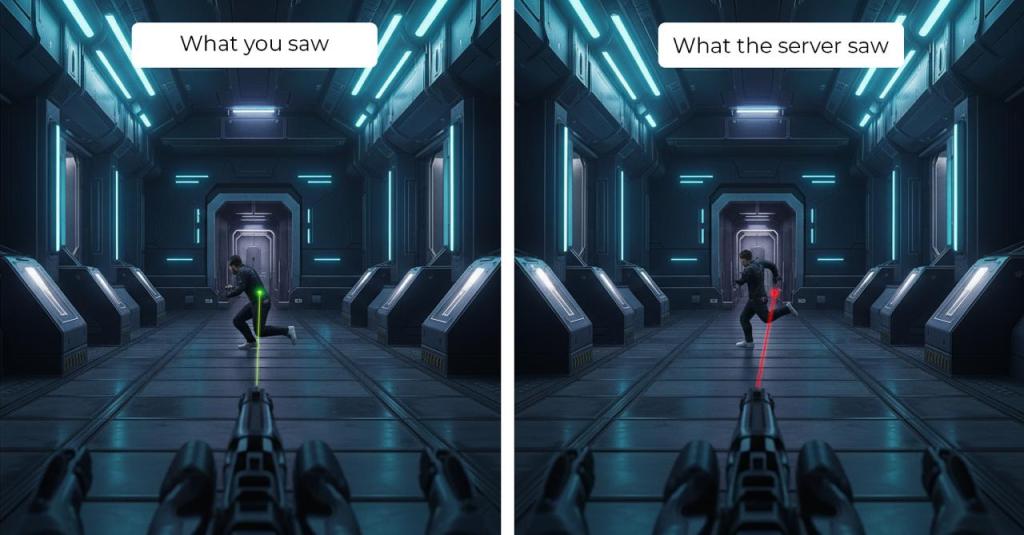
End of a hard week. You and your friends across the world sit down to reignite your rivalries. Lobbies loaded. Call of Duty or FIFA, take your pick. The moment for glory comes. Final seconds. Enemy in your crosshairs. You pull the trigger. You jump in jubilation, only to see your opponents victorious. You slump back in a daze as your platoon roasts you through your headphones, echoing between your ears. “You are so bad. Just a simple shot.” But you know you did not miss. It was lag. The server was not in Accra. The distance made the difference. Your inputs took the long road and arrived too late.
What gamers experience when servers are hosted overseas
When Ghanaian players connect to servers in Europe or North America, packets travel thousands of kilometres. Even at the speed of light in fibre, distance adds delay. A practical rule of thumb is roughly 5 microseconds per kilometre in fibre (about 5 ms per 1,000 km one way). On a 5,000 km path, physics alone adds around 25 ms one way and ~50 ms round trip before you include routing, peering and queueing overheads. In real routes to Europe and North America, that budget climbs further. Put simply, every extra 1,000 km costs about 10 ms of round-trip time before routing and congestion. That delay turns up in aim duels, hit registration and movement. In fast shooters, extra latency measurably reduces performance in competitive play. In football titles, button presses feel like they hang. In battle royales, you lose trades you should win.
Ping, lag and matchmaking: why it matters
For competitive games, consistency is everything. High ping and jitter throw off aim timing and make shot registration feel unfair. Peeker’s advantage becomes more pronounced. Matchmaking can struggle to form stable lobbies if the region pulls players to far-off servers. For creators, long round-trip paths to remote ingest servers increase dropped frames during busy evenings, hurting audience retention. As a rule of thumb, many players aim for sub-50 ms; penalties above ~100–150 ms become obvious. Consistency matters as much as raw ping, so watch jitter and packet loss. Hosting locally and peering directly help keep both ping and jitter low.
Why low-latency, local hosting unlocks better performance
Hosting game servers and related services in Ghana brings the action closer to players. Shorter paths reduce ping and jitter, improve hit registration, and make aim and movement feel responsive. It also helps matchmakers place Ghanaian players together more often, stabilising lobbies at peak times.
Two market shifts make local hosting in Ghana particularly attractive right now:
- New subsea capacity and resilience. Systems like Equiano and 2Africa are transforming international capacity to and from Africa, improving resilience and lowering latency to global platforms.
- Neutral peering in Accra. A public Internet exchange in Accra gives networks and platforms a place to peer locally, which reduces back-and-forth traffic to Europe and improves local traffic flows.
The opportunity for local esports, game dev and content creators
Lower latency and better peering change the equation for Ghana’s gaming ecosystem:
- Esports. Tournament servers hosted locally cut ping variance, reduce lobby instability and allow broadcast teams to produce cleaner shows.
- Game studios. Faster builds, asset sync and patch distribution improve team velocity. Local mirrors and CI/CD runners speed up daily work.
- Creators. Stable upstreams and local peering with global platforms reduce buffering and dropped frames during live shows.
Across the continent, the games market is expanding quickly, driven by mobile and a surge of new players. As revenues rise, demand for reliable low-latency infrastructure follows.
Infrastructure building blocks for low-latency gaming in Ghana
For fast, fair online play, the infrastructure recipe is simple:
- Proximity. Host game servers and ingest/relay nodes in Accra or as close to players as possible.
- Neutral interconnection. Use a carrier-neutral data centre with a public Internet exchange so ISPs, platforms and CDNs can peer locally.
- Redundant connectivity. Multiple carriers and diverse fibre routes to keep latency low and stable during faults.
- Resilient power. UPS, generators and, where available, on-site solar to keep services online.
- Edge services. Local caches, patch mirrors and CI/CD runners to speed updates and dev workflows.
Accra already has these building blocks in place through neutral facilities and a live Internet exchange. Onix is one of the providers delivering a Tier IV-certified, carrier-neutral environment that supports this model without locking anyone in.
What this means in practice
- Lower ping for players. Servers in Accra remove thousands of kilometres of round-trip distance. Physics is on your side.
- Smoother tournaments. Teams play on stable lobbies with fair hit registration and fewer disconnects.
- Happier viewers. Local peering reduces the hop count to platforms, which cuts buffering during live streams.
- Serious uptime. Tier IV design with 99.995 percent expected availability keeps brackets, streams and patch servers online.
Checklist to host locally in Ghana
- Pick a neutral home. Choose a carrier-neutral site in Accra with easy cross-connects and access to the public IXP.
- Connect smart. Peer locally, add cross-connects to multiple ISPs, and keep at least two diverse routes.
- Place the right workloads locally. Start with matchmakers and tournament servers, then add update mirrors, ingest/relay, VOD cache and build runners.
- Measure and iterate. A/B test ping, jitter and packet loss. Expand once the numbers prove out.
- Design for resilience. Confirm power, cooling and maintenance windows to protect events and leagues.
If you run an esports platform, studio or creator network in Ghana, pilot a local host. Coordinate with your ISP, community organisers and a neutral data-centre operator in Accra to spin up a small server or relay and measure the latency win. Contact us here to discuss further.